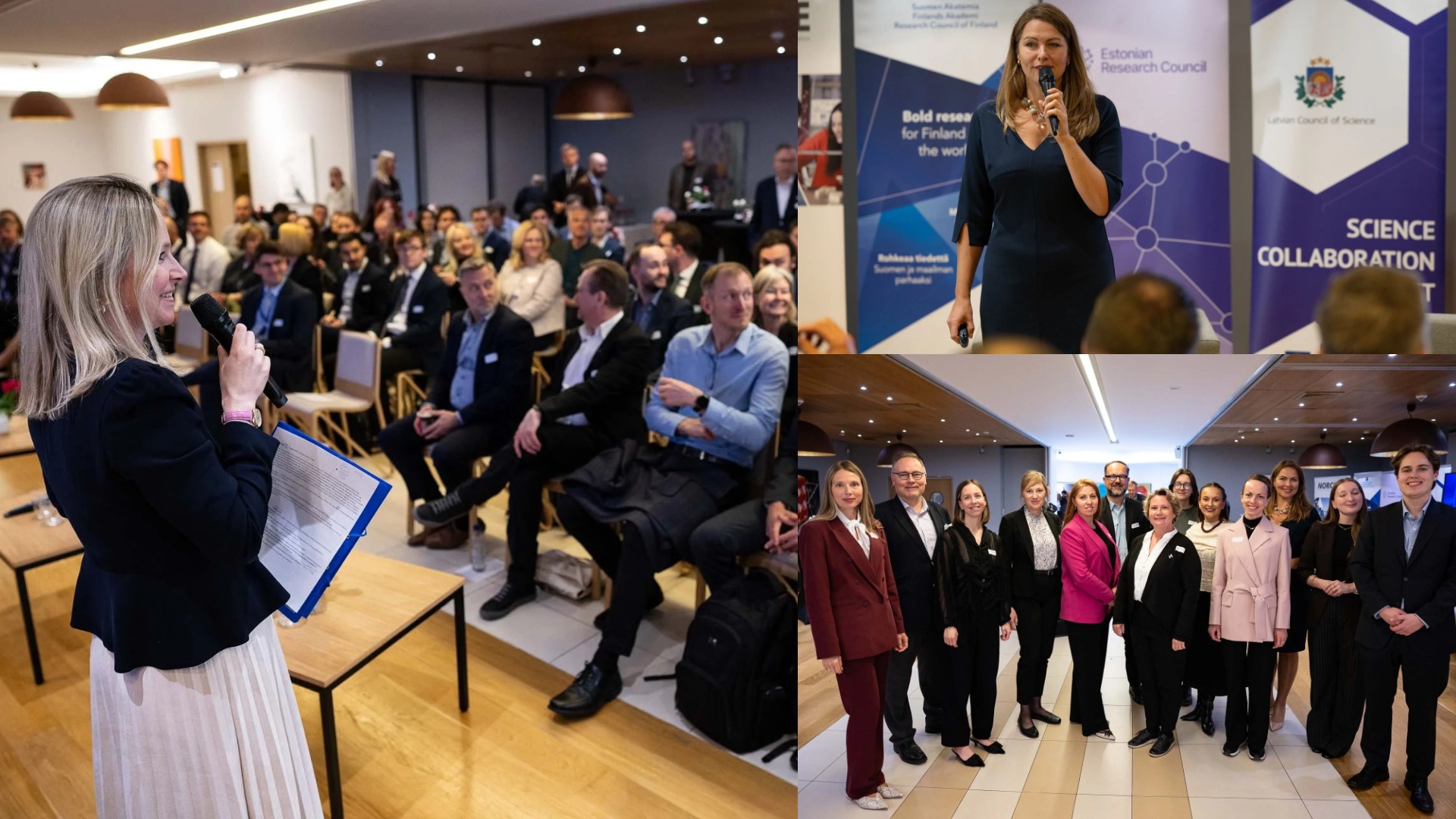
At the Northern Prospects: Bridging Industry and Academia for Dual‑Use conference in Brussels on 7 May, policymakers, researchers, funders, and innovators from across the Nordic‑Baltic region converged on a strikingly consistent message: Europe has all the knowledge and concepts needed. The next step is to build on trust and strengthen interoperability to create an environment supportive of dual use innovation.
Set against a backdrop of geopolitical instability and rapidly evolving security needs, the conference explored how civil and defence innovation ecosystems can work together more effectively. Participants repeatedly challenged the idea that dual use can be solved through definitions or regulation alone. Instead, they argued, success depends on trust, coordination, and the ability to move knowledge into application at speed.
Throughout the day, the Nordic‑Baltic region was highlighted as a natural testing ground for new dual‑use approaches. Small, well‑connected systems, high trust in public institutions, and long traditions of cross‑sector cooperation allow the region to move faster than larger, more fragmented ecosystems.
Dual use: a context, not a category
Across multiple sessions, speakers rejected rigid definitions of “dual use”. Technologies such as AI, photonics, advanced materials, energy systems, and digital infrastructure are not inherently civilian or military; their relevance emerges through use cases, users, and timing. Trying to label technologies too early, especially at low technology‑readiness levels, risks constraining research and discouraging collaboration.
From the European Commission’s perspective, flexibility has become a feature rather than a flaw. Both the European Innovation Council (EIC) and the European Defence Fund (EDF) now rely on contextual, programme‑specific approaches, prioritising market entry potential and deployment pathways over legal categorisation. The goal is speed and adaptability, not conceptual purity.
From research to deployment: where Europe struggles
While Europe produces strong science and promising innovations, too many solutions stall between prototype and deployment. The panels focusing on practical collaboration highlighted familiar bottlenecks: fragmented funding, short project cycles, loss of skills between grants, opaque procurement processes, and limited access to real operational environments.
A recurring theme was the tension between scientific rigor and operational urgency. Defence and security users often need solutions within months, not years. Yet speakers were clear that speed does not require sacrificing quality. Instead, rigorous methods must be embedded closer to use, with continuous feedback between researchers and end users. Long‑term investment in people, doctoral training, and research infrastructure remains essential—without it, rapid response is impossible.
Testbeds as Europe’s missing infrastructure
One of the strongest messages concerned the role of testbeds. Far from being demonstration tools, testbeds were described as instruments of credibility and learning, places where technologies can fail safely, adapt quickly, and earn user trust. Real‑world environments such as energy systems, transport networks, digital infrastructure, and public security services were identified as Europe’s underused assets.
The main barriers, participants noted, are rarely technical. Legal uncertainty, liability, data access, procurement rules, and risk aversion often prevent meaningful experimentation. Speakers called for “safe‑to‑fail” regulatory spaces and stronger intermediaries capable of bridging researchers, companies, users, and regulators.
The bottom line
The conference concluded with a clear takeaway: Europe does not lack ideas, talent, or even funding. The next step for Europe is to build further on mutual trust, strengthen interoperability between national systems, and create an environment supportive of dual use innovation. Dual‑use innovation is less about drawing boundaries and more about building bridges between academia and industry, between innovation and procurement, and between long‑term knowledge and urgent need. As one speaker put it succinctly: connection is capability.


