The topic
Development of artificial intelligence (AI) is high on the agenda in the EU and globally. It is also a race that Europe cannot afford to lose. AI is being integrated to most, if not all, aspects of our lives. Often this integration happens quicker than people adjust to it.
One of the areas where AI effects are felt already – and will undoubtedly be felt in the future – is the world of work.
Our daily jobs, professions, occupations are being transformed. Some jobs become irrelevant, new ones appear. Many people find meaning through their work, and many will have to find a new meaning due to their earlier work being transformed.
At the same time, there is a possibility of much more unemployment or leisure than our societies have been used to. Again, the question of finding a meaning in one’s life appears. At the same time, there arise certain new practical questions, such as universal or unconditional basic income.
The event
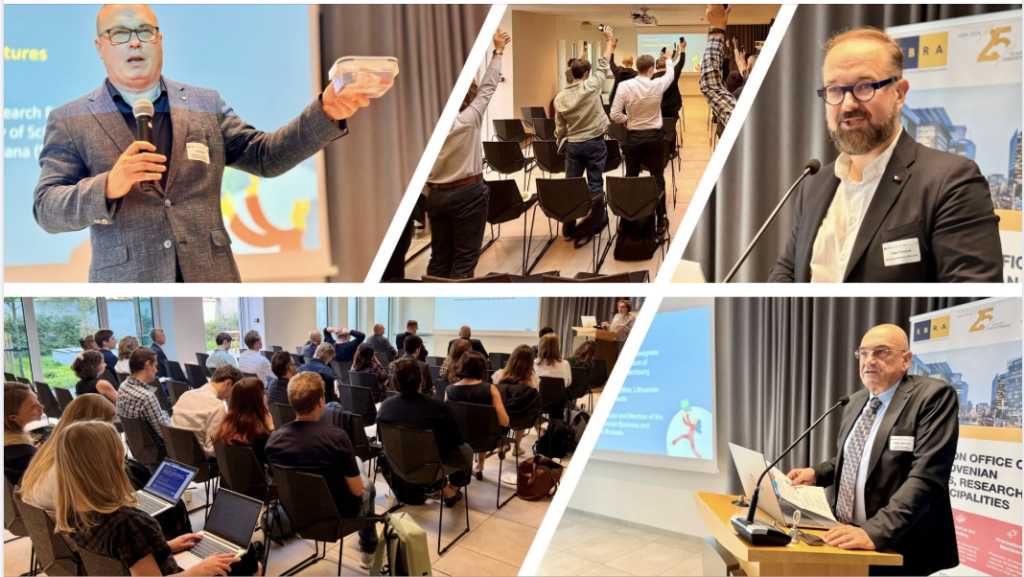
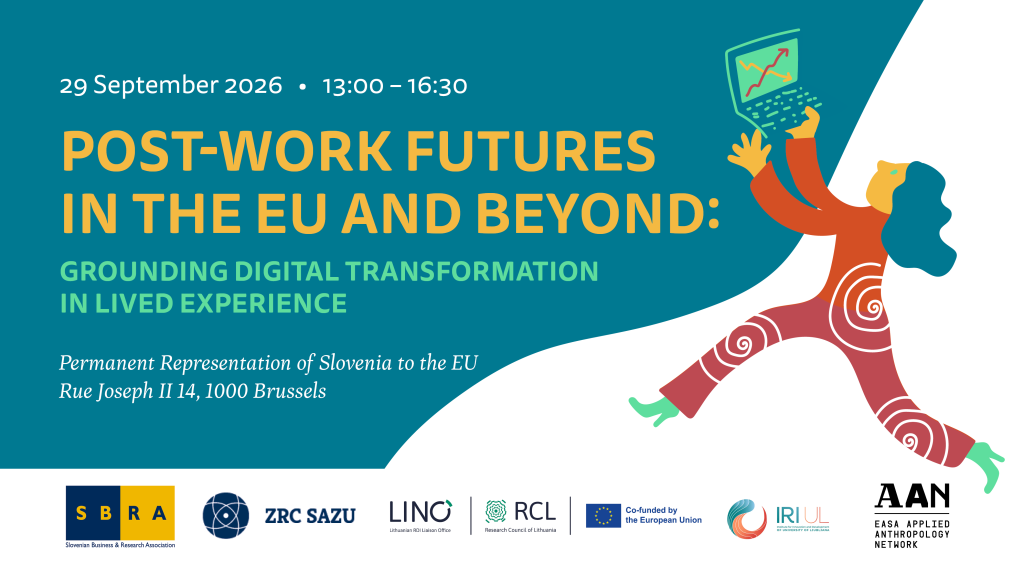
On 29 September 2026, we tried to look into all these questions (and more) at the “Post-work futures in the EU and beyond” conference in Brussels.
The event was organised by LINO, together with the Applied Anthropology Network (AAN) of the European Association of Social Anthropologists (EASA) and the Slovenian Business and Research Association (SBRA).
The speakers came from three distinct stakeholder groups:
- EU policymakers – namely, the European Commission’s Joint Research Centre (JRC) and DG EMPL;
- practising social anthropologists – to provide their social sciences and humanities (SSH) angle;
- European citizens, including the European Citizens Initiative on unconditional basic income.
The discussions evolved around EU foresight and policies, lived experiences of various groups of society (including remote workers and re-emigrees), specific SSH insights that could be handy for policymakers, inputs from certain citizens groups, such as that on UBI.
There was also a small interactive workshop where everyone was invited to create a ‘time capsule’ for themselves five years from now (including how they see the future of their own work).
Acknowledgements and further info
We thank all the inspiring presenters, attendants and coorganisers of this event, proving the relevance of social sciences and humanities in “mediating” societal changes and the importance of dialogues and discussions.
We want to draw your attention to the following work by our speakers and partners:
- JRC’s EU Policy Lab – a collaborative and experimental space for innovative policymaking
- AAN and its annual conference “Why the World Needs Anthropologists” that takes place every autumn in a different location
- ERC-funded ongoing research project ReWorkChange on remote work and social change (coordinated by prof. Elisabetta Costa at the Antwerp University)
- Professor, author, public speaker Dan Podjed, Slovenia (the founder of the AAN)
- Centre for Social Anthropology at Vytautas Magnus University, Lithuania
- EU participatory democracy tool “European Citizens Initiative” (our event included attendants from the Citizen’s Initiative on UBI)
- Slovenian Business and Research Association (SBRA) – serves as a connecting point for Slovenian and international stakeholders
- Designs for our event were created by Michaela Ahonen – a human (rather than AI) designer, located in Finland.
- Finally, LINO is the Brussels branch of the Research Council of Lithuania
A few snapshots from the event
Images taken by our event partners SBRA: