


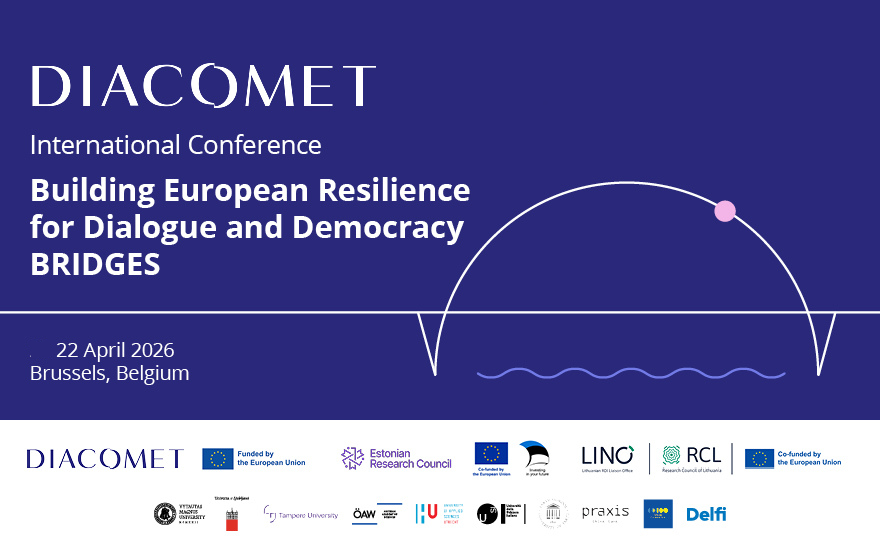
LINO office is pleased to invite you to an international conference on how to increase European resilience to disinformation by improving the culture of public communication and strengthening dialogue. This conference is jointly organised with the DIACOMET research consortium led by the Vytautas Magnus University (Lithuania), containing project partners from Finland, Estonia, Lithuania, Austria, Italy, Slovenia, Hungary, and the Netherlands. The 22 April conference anticipates a full and informative schedule and is fully open to all interested members of the public.
The event is in-person only, and advance registration is mandatory.
Relevance of the event
European democracies are navigating turbulent times marked by multiple risks and polycrisis. Erosion of trust in news media and democratic institutions, growing populism and political extremism, disinformation and hybrid threats, as well as radical movements fuelled by fear and anger, signal democratic backsliding and a broader moral crisis. DIACOMET research across eight European countries reveals that deep political and social polarisation is among the most pervasive and ethically troubling features of contemporary democratic societies. Citizens often feel that their voices are unheard or insufficiently represented and consequently they feel disengaged from the public debate, particularly in contexts marked by conflicting opinions and views.
Sound, inclusive and accountable public communication is pivotal to robust democracy and resilient civil society, laying the foundation for public trust, participatory governance and civic engagement. Unforeseen challenges and disruptive processes in the European media and communication landscape call for innovative solutions and alternative scenarios to underpin evidence-informed policymaking, robust public governance and inclusive citizen dialogue in a networked society.
Grounded in a respect for human rights and democratic values, dialogic communication ethics approach can enhance the quality of public communication and suggest normative and ethical standards for communication culture. In response, DIACOMET proposes a set of practical tools (Principles of Good Communication Conduct, dilemma game, online forum, inclusive accountability toolbox, policy manuals and other outputs) designed to foster inclusive dialogue, democratic resilience and relational engagement across digital disruption, social tensions and political divides.
Objectives
International conference aims to contribute to evidence-informed, collaborative policymakingand participatory democracy by promoting dialogic engagement through research, innovation and policy action. Building on DIACOMET research evidence, we seek to create bridges between knowledge, policy and practice by fostering closer cooperation and sustained dialogue among researchers, media professionals, civil society actors and decision-makers.
Participants
This multi-stakeholder event will convene policymakers, journalists and media professionals, members of academic and education community, NGOs, and civil society actors to contribute to EU-level dialogue and policy reflection with evidence-informed expertise. It alignswith the EU priorities to reinforce democratic culture, civic empowerment and sustainable futures amid growing geopolitical tensions, hybrid threats and accelerating digitalisation.
Key topics
To respond to the current confrontational nature of public communications and to advance common understanding of communication ethics and accountability, the knowledge-informed policy dialogues will be offered as panels, roundtables, game workshop and interviews focusing on the following topics:
- Polarization, disconnection and democratic backsliding
- New vulnerabilities and policy uptake
- Media & information literacy and continuous education
- Communication ethics and inclusive accountability mechanisms
- Democratic resilience and civil society empowerment
- Digital transformation and AI-enhanced communication
- Dialogic capacity building, tools, applications
Organisers
The DIACOMET consortium (project partners from Lithuania, Finland, Estonia, Lithuania, Austria, Italy, Slovenia, Hungary, and the Netherlands); Lithuanian RDI Liaison Office in Brussels; Vytautas Magnus University (project co-ordinator).
The DIACOMET project
DIACOMET proposes a novel approach to communication ethics and inclusive accountability mechanisms applicable to networked societies and their diverse range of communication actors, from legacy media to online influencers. Dialogic Communication Ethics (DCE) offers an innovative framework for interpreting communication challenges by fostering free and constructive deliberation among actors, strengthening citizens’ engagement in public communication, and ultimately enhancing societies’ capacities to prevent, reduce and withstand dysfunctional or destructive interaction.
DIACOMET has received funding from the EU Horizon Europe research and innovation programme under Grant Agreement No. 101094816.
Contacts and further info
Kristina Juraitė, kristina.juraite@vdu.lt; Eglė Gerulaitienė, egle.gerulaitiene@vdu.lt
For Brussels-related practicalities you can also get in touch with Agnė Drumelytė, agne.drumelyte@lmt.lt
We look forward to seeing you at the event!


